Cat-a-comb
Speed tactics in a tin can
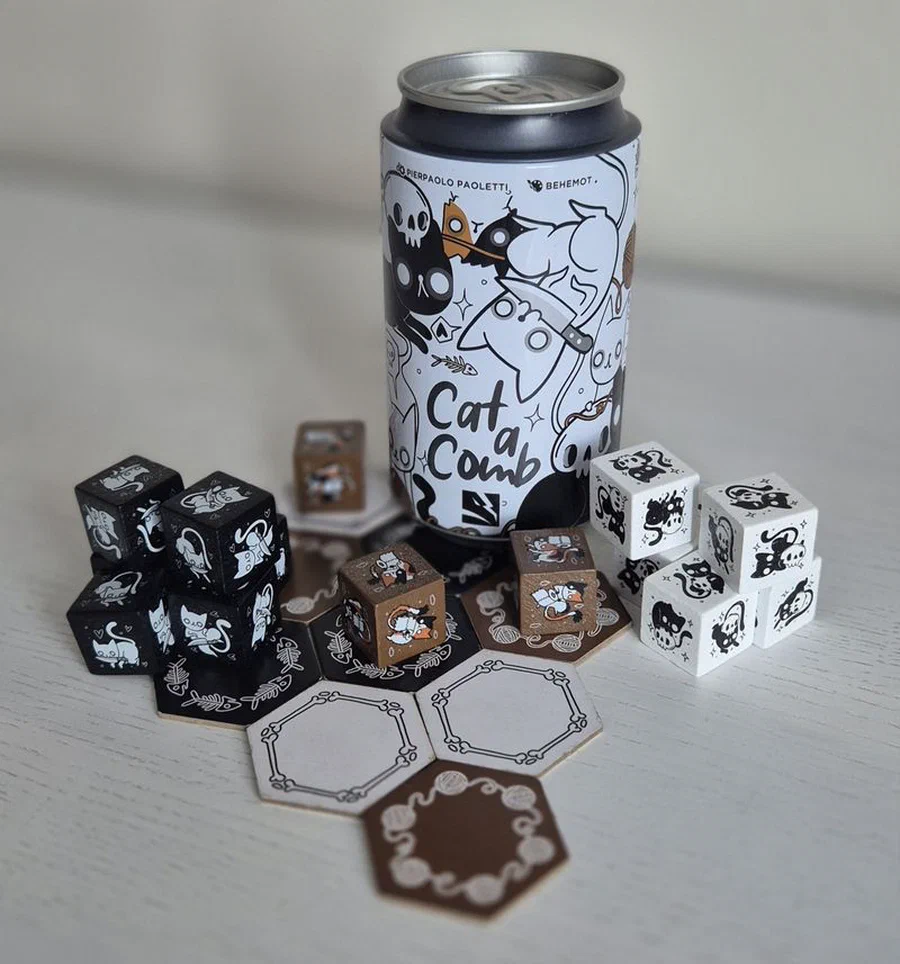
Cat-a-Comb (Cat-a-Comb) is one of the Soda Pop series games, first released in 2024 by designer Pierpaolo Paoletti and publisher ThunderGryph Games. It is a clear proof that depth does not depend on size or production. The designer packed a tense, interesting game into a 0.33 L tin decorated with funny cats and skulls in the spirit of the indie strategy Mewgenics. Besides the compact package, setup is fast and the footprint tiny — you can lay it out in a minute on a café table, windowsill, or bar.
Board
The rules are short and clear. Each player starts with six cubes of their colour (black or white) showing cats. Play begins by placing three neutral (brown) cat cubes on the board. The player who places the neutrals moves second.
There are two win conditions: control three hexes of one colour, or control three towers of three cats regardless of hex colour. We will not reprint the full rules — you can find them here.
You can roughly split a game into the classic chess phases: opening, middlegame, and endgame.
Opening
A critical stage — losing it shapes the rest of the game. Players try to bring cats onto the board quickly for room to manoeuvre. Move order matters a lot: the second player is worse off and by their second turn often cannot place a cat and must start dismantling towers instead of growing presence.Middlegame
Roughly after each side has four cats on the board. Active attacks begin; watch carefully that the opponent does not take two hexes of one colour while you try to do the same. At beginner level many games end here.Endgame
At least one player has five cats on the board. The second win condition becomes much more likely — besides regions, watch for three-high towers.
Strategy and tactics tips:
Lone cat
Not a named trick, but beginners forget it: a one-cat tower is still a tower and can be dismantled the same way — just move the cat to a neighbouring hex or tower (when the rules allow).
Centre of the room
Central hex b2 is important: from there one cat reaches almost every other cell (except a1 and c3).
Opening deconstruction
When your only legal move in the opening is dismantling a tower, dismantle a tower controlled by an opponent cat. That restores tempo so you can place a cube next turn. Dismantling a tower you control usually lets the opponent cover a neutral with theirs next, forcing you to dismantle again instead of placing.
Seizing the initiative
Seizing the initiative. Sample starting layout.
Last cat
It is often better not to place every cat: hold the last one in hand until bringing it out flips the board or ends the game.
Stripped tail
White wins by taking brown hexes (b2 -> b1 - b2 - c2)
In closing: the lack of strategic space from the tiny 3×3 board is more than made up for by stacking, which adds another dimension and turns games into sharp battles where every move counts.
I am sure this is not a complete list of ideas. If you know more — share them and we can discuss.